
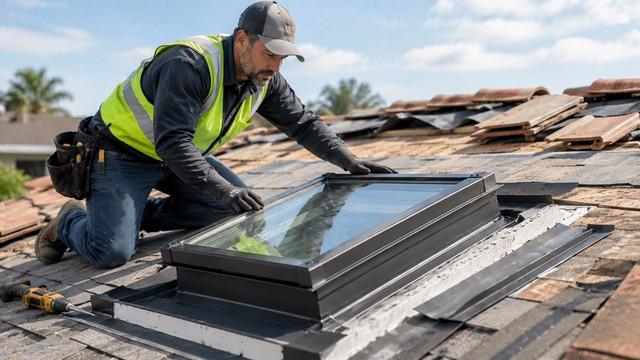
Replacing a skylight during a reroof works best when the skylight is treated as a coordinated system, not an accessory added after the roof order is complete. The existing unit, opening, mounting type, roof covering, flashing, and project documents all affect what needs to be ordered.
The reroof creates a practical coordination window because the surrounding roofing material is already being removed and rebuilt. It also creates a deadline: the correct unit and compatible components need to be identified before the crew reaches the opening.
Use the workflow below to create a clean order handoff without guessing at manufacturer-specific sizes or installation details.
TL;DR
- Confirm who is deciding whether the existing skylight will be reused or replaced.
- Identify the current unit by manufacturer, model information, operation, mounting type, and photos.
- Record the roof covering, slope context, opening measurements, curb conditions, and interior finish.
- Match the replacement unit and flashing through current manufacturer documentation.
- Put the skylight, flashing, accessories, delivery timing, and unresolved questions in one order handoff.
Decide Who Owns the Replace-or-Reuse Call
The material order should not silently make the decision to reuse or replace an existing skylight. Confirm who owns that decision and what information they need. Depending on the project, that may involve the property owner, roofing contractor, manufacturer, project professional, or another responsible party.
Age, visible condition, prior leakage, condensation, glazing condition, operation, curb condition, and access may all be relevant, but they do not create a universal replacement rule. Manufacturer guidance can also affect the conversation. For example, VELUX currently recommends coordinating skylight replacement with a roof replacement for its products, but that guidance should not be applied automatically to every brand or unit.
Record the decision before pricing the skylight package. If the decision is still open, label the proposal and material request accordingly.
Identify the Existing Unit Before Selecting a Replacement
Begin with the information already on the skylight. Look for a manufacturer label, model code, serial number, or other product marking. The VELUX product identification guide, for example, explains that its product marking can identify the model, glass type, and manufacturing date. Other manufacturers may place or format identification differently.
Capture wide and close photos from safe, authorized locations. Include the interior opening, exterior frame or curb, surrounding roof material, flashing condition, and any readable label. Note whether the unit is fixed or operable and whether controls, shades, screens, or electrical components are involved.
A request with photos and known job details is easier to review than a message that says “standard skylight.” Use those details to review skylights and roofing materials with our team. The same principle applies to the rest of the order, as explained in Roofing Material Quotes: The Exact Job Details Contractors Should Send to Get Pricing Faster.
Confirm Whether It Is Deck-Mounted or Curb-Mounted
Mounting type is a basic ordering distinction. A deck-mounted skylight is designed to attach directly at the roof deck with its manufactured frame or flange. A curb-mounted skylight sits over a raised curb that is separate from the skylight unit.
Those descriptions are useful for identification, but the replacement still needs to follow the selected manufacturer’s current terminology and instructions. Do not assume a unit will fit because its visible glass dimensions look similar. The outside frame, curb, rough opening, and required clearances can tell different stories.
If an existing curb will remain, document its outside dimensions, height, construction, condition, and any project direction about alteration or replacement. If the order calls for a deck-mounted unit, confirm the rough-opening information and the exact model size through current documentation.
Match the Unit and Flashing to the Roof Covering
Flashing is not a generic add-on. The correct system can depend on the skylight model, mounting type, roof covering, roof slope, and whether the unit is installed alone or in a group.
Use the roof material as an ordering input
Record whether the reroof uses shingles, tile, metal, or another covering, along with the known profile or thickness information. VELUX’s current flashing-system documentation illustrates why this matters: it separates deck-mounted and curb-mounted kits and identifies different systems for shingles, tile, and metal. Those kit names and limits are specific to VELUX, but the broader ordering lesson applies across brands.
Verify the exact flashing path
Use the selected skylight manufacturer’s current instructions to match the unit and flashing. Then compare that system with the project’s underlayment, roof detail, and surrounding material. You can use our roof flashing order-planning guide to check the surrounding categories without substituting it for the manufacturer detail.
When you review the order with our team, bring the unit identity, mounting type, measurements, roof covering, and flashing questions together. Do not release the skylight first and plan to find a flashing kit later.
Measure the Opening and Capture the Conditions
Measurements are part of the order record, not a substitute for product identification. Record the dimensions requested by the chosen manufacturer and label each one clearly. Avoid sending an unlabeled width and length that could refer to the glass, frame, curb, roof opening, or interior drywall.
VELUX’s current replacement guidance asks for measurements at the exterior skylight and flashing area, the skylight or curb height, and the interior opening. It also recommends photos showing the tape measurements. Use the equivalent current measurement guide for the brand being ordered.
Document anything that can affect the handoff: altered framing, a damaged curb, unusual interior finishes, grouped units, electrical controls, roof-access limitations, or a mismatch between the visible unit and the project documents. Send structural, framing, or design questions to the responsible project professional.
Build One Complete Skylight Order Handoff
A useful handoff gives the estimator, supplier, and foreman the same facts:
- Project address and responsible contact
- Reuse-or-replace decision and decision owner
- Manufacturer, model, serial information, and unit operation
- Deck-mounted or curb-mounted identification
- Labeled exterior, curb, rough-opening, and interior measurements as applicable
- Roof covering, profile, and known slope context
- Selected flashing system and required accessories
- Current product documents, photos, and unresolved questions
- Needed-on-site date, delivery plan, and receiving contact
If one of those details is unknown, mark it as unknown. A visible open question is safer for the order than an assumption that looks like a confirmed specification.
Coordinate the Reroof Handoff Before Tear-Off
Confirm the skylight package and timing before the crew removes the surrounding roof. The foreman should know which unit is assigned to each opening, where the flashing and accessories are staged, and which instructions control the installation.
Our team can help organize the known product and delivery details. Bring the complete handoff early enough for availability, special-order status, and delivery options to be reviewed before the reroof schedule depends on them.
Frequently Asked Questions
Should a skylight always be replaced during a reroof?
No universal rule fits every unit. Review the skylight’s identity, age, condition, operation, leakage history, manufacturer guidance, project scope, and the responsible parties’ decision before ordering.
What is the ordering difference between deck-mounted and curb-mounted skylights?
A deck-mounted unit attaches directly at the roof deck through its manufactured frame or flange. A curb-mounted unit fits over a separate raised curb. The mounting type affects unit selection, measurements, and compatible flashing.
Can one skylight flashing kit be used with any roof material?
No. Manufacturers may specify different flashing systems for shingles, tile, metal, roof profiles, slopes, mounting types, and product models. Verify the exact combination in current manufacturer documentation.
What should a contractor send when requesting a replacement skylight?
Send the project address, unit manufacturer and identification, operation type, mounting type, labeled measurements, roof material, photos, desired replacement scope, relevant documents, and any known flashing or accessory requirements.